|
|
| Line 1: |
Line 1: |
| − | ==1,2,3-Trichloropropane (TCP)== | + | ==PFAS Leaching Characterization with the Leaching Environmental Assessment Framework (LEAF)== |
| − | [[Wikipedia: 1,2,3-Trichloropropane | 1,2,3-Trichloropropane (TCP)]] is a chlorinated volatile organic compound (CVOC) that has been used in chemical production processes, in agriculture, and as a solvent, resulting in point and non-point source contamination of soil and groundwater. TCP is mobile and highly persistent in soil and groundwater. TCP is not currently regulated at the national level in the United States, but [[Wikipedia: Maximum contaminant level | maximum contaminant levels (MCLs)]] have been developed by some states. Current treatment methods for TCP are limited and can be cost prohibitive. However, some treatment approaches, particularly [[Chemical Reduction (In Situ - ISCR) | ''in situ'' chemical reduction (ISCR)]] with [[Wikipedia: In_situ_chemical_reduction#Zero_valent_metals_%28ZVMs%29 | zero valent zinc (ZVZ)]] and [[Bioremediation - Anaerobic | ''in situ'' bioremediation (ISB)]], have recently been shown to have potential as practical remedies for TCP contamination of groundwater. | + | [[Wikipedia: Firefighting_foam#Synthetic_foams | Aqueous film-forming foams (AFFFs)]] are a major source of [[Perfluoroalkyl and Polyfluoroalkyl Substances (PFAS) | per- and poly-fluoroalkyl substances (PFAS)]] impacts in soil and groundwater. Standardized tools are needed to rapidly assess the potential for retention, leaching, and transport of PFAS from the source zone to downgradient regions, so that this information can be applied towards critical facets of site management such as prioritizing PFAS-impacted sites for further investigation and remediation. Existing standard leaching methods were developed prior to concerns regarding PFAS. Therefore, studies are needed to ensure that leaching methods are compatible for use with PFAS and that resulting data are representative of the risk of PFAS leaching at impacted sites. |
| | <div style="float:right;margin:0 0 2em 2em;">__TOC__</div> | | <div style="float:right;margin:0 0 2em 2em;">__TOC__</div> |
| | | | |
| | '''Related Article(s):''' | | '''Related Article(s):''' |
| − | *[[Bioremediation - Anaerobic | Anaerobic Bioremediation]]
| |
| − | *[[Chemical Reduction (In Situ - ISCR) | ''In Situ'' Chemical Reduction (ISCR)]]
| |
| − | *[[Chemical Oxidation (In Situ - ISCO) | ''In Situ'' Chemical Oxidation (ISCO)]]
| |
| | | | |
| − | '''Contributor(s):'''
| + | *[[Perfluoroalkyl and Polyfluoroalkyl Substances (PFAS)]] |
| − | *[[Dr. Alexandra Salter-Blanc | Alexandra J. Salter-Blanc]] | + | *[[PFAS Sources]] |
| − | *[[Dr. Paul Tratnyek | Paul G. Tratnyek]] | + | *[[PFAS Transport and Fate]] |
| − | *John Merrill
| |
| − | *Alyssa Saito
| |
| − | *Lea Kane
| |
| − | *Eric Suchomel
| |
| − | *[[Dr. Rula Deeb | Rula Deeb]] | |
| | | | |
| − | '''Key Resource(s):''' | + | '''Contributors:''' Dr. Jennifer L. Guelfo, Dr. David Kosson, Dr. Andy Garrabrants, Ms. Fangfei Liu, Mr. Darlington Yawson, Dr. Md. Isreq Real |
| − | *Prospects for Remediation of 1,2,3-Trichloropropane by Natural and Engineered Abiotic Degradation Reactions. Strategic Environmental Research and Development Program (SERDP), Project ER-1457.<ref name="Tratnyek2010">Tratnyek, P.G., Sarathy, V., Salter, A.J., Nurmi, J.T., O’Brien Johnson, G., DeVoe, T., and Lee, P., 2010. Prospects for Remediation of 1,2,3-Trichloropropane by Natural and Engineered Abiotic Degradation Reactions. Strategic Environmental Research and Development Program (SERDP), Project ER-1457. [https://serdp-estcp.org/Program-Areas/Environmental-Restoration/Contaminated-Groundwater/Emerging-Issues/ER-1457/ER-1457/(language)/eng-US Website] [[Media: ER-1457-FR.pdf | Report.pdf]]</ref>
| |
| | | | |
| − | *Verification Monitoring for In Situ Chemical Reduction Using Zero-Valent Zinc, A Novel Technology for Remediation of Chlorinated Alkanes. Strategic Environmental Research and Development Program (SERDP), Project ER-201628.<ref name="Kane2020">Kane, L.Z., Suchomel, E.J., and Deeb, R.A., 2020. Verification Monitoring for In Situ Chemical Reduction Using Zero-Valent Zinc, A Novel Technology for Remediation of Chlorinated Alkanes. Strategic Environmental Research and Development Program (SERDP), Project ER-201628. [https://www.serdp-estcp.org/Program-Areas/Environmental-Restoration/Contaminated-Groundwater/Persistent-Contamination/ER-201628 Website] [[Media: ER-201628.pdf | Report.pdf]]</ref> | + | '''Key Resources:''' |
| | + | *Development of Leaching Tests for Materials Containing SVOCs and PFAS, EPA 600/R-23/382<ref name="GarrabrantsEtAl2024"/> |
| | | | |
| − | ==Introduction==
| + | *[https://www.epa.gov/hw-sw846/leaching-environmental-assessment-framework-leaf-methods-and-guidance Leaching Environmental Assessment Framework (LEAF) Methods and Guidance] (EPA website) |
| − | [[File:123TCPFig1.png|thumb|left|Figure 1. Ball and stick representation of the molecular structure of TCP (Salter-Blanc and Tratnyek, unpublished)]]
| |
| − | 1,2,3-Trichloropropane (TCP) (Figure 1) is a man-made chemical that was used in the past primarily as a solvent and extractive agent, as a paint and varnish remover, and as a cleaning and degreasing agent.<ref name="ATSDR2021"> Agency for Toxic Substances and Disease Registry (ATSDR), 2021. Toxicological Profile for 1,2,3-Trichloropropane. Free download from: [https://www.atsdr.cdc.gov/toxprofiles/tp57.pdf ATSDR] [[Media: TCP2021ATSDR.pdf | Report.pdf]]</ref>. Currently, TCP is primarily used in chemical synthesis of compounds such as [[Wikipedia: Polysulfone | polysulfone]] liquid polymers used in the aerospace and automotive industries; [[Wikipedia: Hexafluoropropylene | hexafluoropropylene]] used in the agricultural, electronic, and pharmaceutical industries; [[Wikipedia: Polysulfide | polysulfide]] polymers used as sealants in manufacturing and construction; and [[Wikipedia: 1,3-Dichloropropene | 1,3-dichloropropene]] used in agriculture as a soil fumigant. TCP may also be present in products containing these chemicals as an impurity<ref name="ATSDR2021"/><ref name="CH2M2005">CH2M HILL, 2005. Interim Guidance for Investigating Potential 1,2,3-Trichloropropane Sources in San Gabriel Valley Area 3. [[Media: INTERIM_GUIDANCE_FOR_INVESTIGATING_POTENTIAL_1%2C2%2C3-TRICHLOROPROPANE_SOURCES.pdf | Report.pdf]] [https://cumulis.epa.gov/supercpad/cursites/csitinfo.cfm?id=0902093 Website]</ref>. For example, the 1,2-dichlropropane/1,3-dichloropropene soil fumigant mixture (trade name D-D), which is no longer sold in the United States, contained TCP as an impurity and has been linked to TCP contamination in groundwater<ref name="OkiGiambelluca1987">Oki, D.S. and Giambelluca, T.W., 1987. DBCP, EDB, and TCP Contamination of Ground Water in Hawaii. Groundwater, 25(6), pp. 693-702. [https://doi.org/10.1111/j.1745-6584.1987.tb02210.x DOI: 10.1111/j.1745-6584.1987.tb02210.x]</ref><ref name="CH2M2005"/>. Soil fumigants currently in use which are composed primarily of 1,3-dichloropropene may also contain TCP as an impurity, for instance Telone II has been reported to contain up to 0.17 percent TCP by weight<ref name="Kielhorn2003">Kielhorn, J., Könnecker, G., Pohlenz-Michel, C., Schmidt, S. and Mangelsdorf, I., 2003. Concise International Chemical Assessment Document 56: 1,2,3-Trichloropropane. World Health Organization, Geneva. [http://www.who.int/ipcs/publications/cicad/en/cicad56.pdf Website] [[Media: WHOcicad56TCP.pdf | Report.pdf]]</ref>.
| |
| | | | |
| − | TCP contamination is problematic because it is “reasonably anticipated to be a human carcinogen” based on evidence of carcinogenicity to animals<ref name="NTP2016"> National Toxicology Program, 2016. Report on Carcinogens, 14th ed. U.S. Department of Health and Human Services, Public Health Service. Free download from: [https://ntp.niehs.nih.gov/ntp/roc/content/profiles/trichloropropane.pdf NIH] [[Media: NTP2016trichloropropane.pdf | Report.pdf]]</ref>. Toxicity to humans appears to be high relative to other chlorinated solvents<ref name="Kielhorn2003"/>, suggesting that even low-level exposure to TCP could pose a significant human health risk.
| + | ==Introduction to LEAF== |
| | + | The [https://www.epa.gov/ U.S. Environmental Protection Agency (EPA)] [https://www.epa.gov/hw-sw846/leaching-environmental-assessment-framework-leaf-methods-and-guidance Leaching Environmental Assessment Framework (LEAF)] is a suite of standardized test methods for evaluating contaminant release from solids under environmentally relevant conditions (Table 1). The four leaching methods within LEAF were originally validated for inorganic constituents<ref>Garrabrants, A.C., Kosson, D.S., Stefanski, L., DeLapp, R., Seignette, P.F.A.B., van der Sloot, H.A., Kariher, P., Baldwin, M., 2012. Interlaboratory Validation of the Leaching Environmental Assessment Framework (LEAF) Method 1313 and Method 1316, EPA/600/R-12/623, U.S. Environmental Protection Agency, Air Pollution and Control Division. [[Media: EPA 600_R-12_623.pdf | Free Download EPA 600/R-12/623]]</ref><ref>Garrabrants, A.C., Kosson, D.S., DeLapp, R., Kariher, P., Seignette, P.F.A.B., van der Sloot, H.A., Stefanski, L., Baldwin, M., 2012. Interlaboratory Validation of the Leaching Environmental Assessment Framework (LEAF) Method 1314 and Method 1315, EPA/600/R-12/624, U.S. Environmental Protection Agency, Air Pollution and Control Division. [[Media: EPA 600_R-12_624.pdf | Free Download EPA 600/R-12/624]]</ref> and included as standard leaching methods EPA 1313 – 1316 within Update V of SW-846<ref>USEPA, 2026. Hazardous Waste Test Methods / SW-846. [https://www.epa.gov/hw-sw846 USEPA SW-846 website]</ref>. To address the need for standardized tests to evaluate PFAS leaching and mobility, LEAF methods have been optimized and demonstrated for use with PFAS (Methods 1313A-1316A)<ref name="GarrabrantsEtAl2024">Garrabrants, A.C., Liu, F., Warne, R., DeLapp, R., Brown, L., Rubin, Z., Yawson, D., Kosson, D.S., Guelfo, J.L., Real, M.I., van der Sloot, H.A., Touati, A., Thorneloe, S., 2024. Development of Leaching Tests for Materials Containing SVOCs and PFAS, EPA 600/R-23/382, USEPA, Washington, D.C. [[Media: EPA 600_R-23_382.PDF | Free Download EPA 600/R-23/382]]</ref>. This article will focus on Methods 1313A, 1314A, and 1316A. Demonstration of Method 1315A for compacted granular materials (including concrete and asphalt) is ongoing. |
| | | | |
| − | ==Environmental Fate==
| + | {| class="wikitable" style="float:right; margin-left:10px;" |
| − | TCP’s fate in the environment is governed by its physical and chemical properties (Table 1). TCP does not adsorb strongly to soil, making it likely to leach into groundwater and exhibit high mobility. In addition, TCP is moderately volatile and can partition from surface water and moist soil into the atmosphere. Because TCP is only slightly soluble and denser than water, it can form a [[Wikipedia: Dense non-aqueous phase liquid | dense non-aqueous phase liquid (DNAPL)]] as observed at the Tyson’s Dump Superfund Site<ref name="USEPA2019"> United States Environmental Protection Agency (USEPA), 2019. Fifth Five-year Review Report, Tyson’s Dump Superfund Site, Upper Merion Township, Montgomery County, Pennsylvania. Free download from: [https://semspub.epa.gov/work/03/2282817.pdf USEPA] [[Media: USEPA2019.pdf | Report.pdf]]</ref>. TCP is generally resistant to aerobic biodegradation, hydrolysis, oxidation, and reduction under naturally occurring conditions making it persistent in the environment<ref name="Tratnyek2010"/>.
| + | |+Table 1. EPA SW-846 methods that comprise the LEAF framework |
| − | | |
| − | {| class="wikitable" style="float:right; margin-left:10px;text-align:center;" | |
| − | |+Table 1. Physical and chemical properties of TCP<ref name="USEPA2017">United States Environmental Protection Agency (USEPA), 2017. Technical Fact Sheet—1,2,3-Trichloropropane (TCP). EPA Project 505-F-17-007. 6 pp. Free download from: [https://www.epa.gov/sites/production/files/2017-10/documents/ffrrofactsheet_contaminants_tcp_9-15-17_508.pdf USEPA] [[Media: epa_tcp_2017.pdf | Report.pdf]]</ref> | |
| − | |-
| |
| − | !Property
| |
| − | !Value
| |
| − | |-
| |
| − | | Chemical Abstracts Service (CAS) Number || 96-18-4
| |
| − | |-
| |
| − | | Physical Description</br>(at room temperature) || Colorless to straw-colored liquid
| |
| − | |-
| |
| − | | Molecular weight (g/mol) || 147.43
| |
| − | |-
| |
| − | | Water solubility at 25°C (mg/L)|| 1,750 (slightly soluble)
| |
| − | |-
| |
| − | | Melting point (°C)|| -14.7
| |
| | |- | | |- |
| − | | Boiling point (°C) || 156.8
| + | !Method |
| | + | !Description |
| | |- | | |- |
| − | | Vapor pressure at 25°C (mm Hg) || 3.10 to 3.69 | + | | 1313 || Liquid-solid partitioning as a function of '''''extract pH''''' using a parallel batch extraction (i.e., equilibrium) procedure (Figure 1) |
| | |- | | |- |
| − | | Density at 20°C (g/cm<sup>3</sup>) || 1.3889 | + | | 1314 || Liquid-solid partitioning as a function of '''''liquid-solid ratio (L/S)''''' for constituents in solid materials using an up-flow '''''percolation''''' column procedure (Figure 3) |
| | |- | | |- |
| − | | Octanol-water partition coefficient</br>(log''K<sub>ow</sub>'') || 1.98 to 2.27</br>(temperature dependent) | + | | 1315 || '''''Mass transfer rates''''' of constituents in monolithic or compacted granular materials using a semi-dynamic tank leaching procedure |
| | |- | | |- |
| − | | Organic carbon-water partition coefficient</br>(log''K<sub>oc</sub>'') || 1.70 to 1.99</br>(temperature dependent) | + | | 1316 || Liquid-solid partitioning as a function of '''''L/S''''' using a parallel batch extraction (i.e., '''''equilibrium''''') procedure (Figure 2) |
| | |- | | |- |
| − | | Henry’s Law constant at 25°C</br>(atm-m<sup>3</sup>/mol) || 3.17x10<sup>-4</sup><ref name="ATSDR2021"/> to 3.43x10<sup>-4</sup><ref name="LeightonCalo1981">Leighton Jr, D.T. and Calo, J.M., 1981. Distribution Coefficients of Chlorinated Hydrocarbons in Dilute Air-Water Systems for Groundwater Contamination Applications. Journal of Chemical and Engineering Data, 26(4), pp. 382-385. [https://doi.org/10.1021/je00026a010 DOI: 10.1021/je00026a010]</ref> | + | | colspan="2" style="background:white;" | Note: Text shown in '''''bold''''' indicates primary condition evaluated in each method. |
| | |} | | |} |
| | | | |
| − | ==Occurrence== | + | ==Method Development for PFAS== |
| − | TCP has been detected in approximately 1% of public water supply and domestic well samples tested by the United States Geological Survey. More specifically, TCP was detected in 1.2% of public supply well samples collected between 1993 and 2007 by Toccalino and Hopple<ref name="ToccalinoHopple2010">Toccalino, P.L., Norman, J.E., Hitt, K.J., 2010. Quality of Source Water from Public-Supply Wells in the United States, 1993–2007. Scientific Investigations Report 2010-5024. U.S. Geological Survey. [https://doi.org/10.3133/sir20105024 DOI: 10.3133/sir20105024] Free download from: [https://pubs.er.usgs.gov/publication/sir20105024 USGS] [[Media: Quality_of_source_water_from_public-supply_wells_in_the_United_States%2C_1993-2007.pdf | Report.pdf]]</ref> and 0.66% of domestic supply well samples collected between 1991 and 2004 by DeSimone<ref name="DeSimone2009">DeSimone, L.A., 2009. Quality of Water from Domestic Wells in Principal Aquifers of the United States, 1991–2004. U.S. Geological Survey, Scientific Investigations Report 2008–5227. 139 pp. Free download from: [http://pubs.usgs.gov/sir/2008/5227 USGS] [[Media: DeSimone2009.pdf | Report.pdf]]</ref>. TCP was detected at a higher rate in domestic supply well samples associated with agricultural land-use studies than samples associated with studies comparing primary aquifers (3.5% versus 0.2%)<ref name="DeSimone2009"/>.
| + | Complete details of the development of LEAF Methods 1313A, 1314A, and 1316A for use with PFAS are available in Garrabrants ''et al.'', 2024<ref name="GarrabrantsEtAl2024"/>. Representative method modifications include: |
| | + | * Materials of construction for experimental apparatus: containers used for leaching vessels (Methods 1313A, 1316A) and column construction materials (Method 1314A) evaluated for background PFAS and PFAS uptake. |
| | + | * Reagents and eluant composition: eluant composition was optimized to use 1 mM CaCl2 to reduce formation of colloidal matter; Method 1313A pH adjustment now conducted with nonoxidizing HCl. |
| | + | * Experimental conditions: Longer equilibration times (e.g., Method 1313, 1316) may be required due to slow desorption kinetics of certain PFAS from soil and organic matrices, implementation of settling to facilitate separation of solids from eluates. |
| | + | * Eluate processing (all methods): Use of centrifugation in lieu of eluate filtering, sonication of bottle prior to eluate subsampling. |
| | | | |
| − | ==Regulation== | + | ==Batch Test Demonstration Studies== |
| − | The United States Environmental Protection Agency (USEPA) has not established an MCL for TCP, although guidelines and health standards are in place<ref name="USEPA2017"/>. TCP was included in the Contaminant Candidate List 3<ref name="USEPA2009">United States Environmental Protection Agency (US EPA), 2009. Drinking Water Contaminant Candidate List 3-Final. Federal Register 74(194), pp. 51850–51862, Document E9-24287. [https://www.federalregister.gov/documents/2009/10/08/E9-24287/drinking-water-contaminant-candidate-list-3-final Website] [[Media: FR74-194DWCCL3.pdf | Report.pdf]]</ref> and the Unregulated Contaminant Monitoring Rule 3 (UCMR 3)<ref name="USEPA2012">United States Environmental Protection Agency (US EPA), 2012. Revisions to the Unregulated Contaminant Mentoring Regulation (UCMR 3) for Public Water Systems. Federal Register 77(85) pp. 26072-26101. [https://www.federalregister.gov/documents/2012/05/02/2012-9978/revisions-to-the-unregulated-contaminant-monitoring-regulation-ucmr-3-for-public-water-systems Website] [[Media: FR77-85UCMR3.pdf | Report.pdf]]</ref>. The UCMR 3 specified that data be collected on TCP occurrence in public water systems over the period of January 2013 through December 2015 against a reference concentration range of 0.0004 to 0.04 μg/L<ref name="USEPA2017a">United States Environmental Protection Agency (USEPA), 2017. The Third Unregulated Contaminant Monitoring Rule (UCMR 3): Data Summary. EPA 815-S-17-001. [https://www.epa.gov/dwucmr/data-summary-third-unregulated-contaminant-monitoring-rule Website] [[Media: ucmr3-data-summary-january-2017.pdf | Report.pdf]]</ref>. The reference concentration range was determined based on a cancer risk of 10-6 to 10-4 and derived from an oral slope factor of 30 mg/kg-day, which was determined by the EPA’s Integrated Risk Information System<ref name="IRIS2009">USEPA Integrated Risk Information System (IRIS), 2009. 1,2,3-Trichloropropane (CASRN 96-18-4). [https://cfpub.epa.gov/ncea/iris2/chemicalLanding.cfm?substance_nmbr=200 Website] [[Media: TCPsummaryIRIS.pdf | Summary.pdf]]</ref>. Of 36,848 samples collected during UCMR 3, 0.67% exceeded the minimum reporting level of 0.03 µg/L. 1.4% of public water systems had at least one detection over the minimum reporting level, corresponding to 2.5% of the population<ref name="USEPA2017a"/>. While these occurrence percentages are relatively low, the minimum reporting level of 0.03 µg/L is more than 75 times the USEPA-calculated Health Reference Level of 0.0004 µg/L. Because of this, TCP may occur in public water systems at concentrations that exceed the Health Reference Level but are below the minimum reporting level used during UCMR 3 data collection. These analytical limitations and lack of lower-level occurrence data have prevented the USEPA from making a preliminary regulatory determination for TCP<ref name="USEPA2021">USEPA, 2021. Announcement of Final Regulatory Determinations for Contaminants on the Fourth Drinking Water Contaminant Candidate List. Free download from: [https://www.epa.gov/sites/default/files/2021-01/documents/10019.70.ow_ccl_reg_det_4.final_web.pdf USEPA] [[Media: CCL4.pdf | Report.pdf]]</ref>.
| + | PFAS-specific adaptations were tested in batch test demonstration studies, which included triplicate implementation of Methods 1313A and 1316A in four AFFF-impacted site soils. |
| | | | |
| − | Some US states have established their own standards including Hawaii which has established an MCL of 0.6 μg/L<ref name="HDOH2013">Hawaii Department of Health, 2013. Amendment and Compilation of Chapter 11-20 Hawaii Administrative Rules. Free download from: [http://health.hawaii.gov/sdwb/files/2016/06/combodOPPPD.pdf Hawaii Department of Health] [[Media: Amendment_and_Compilation_of_Chapter_11-20_Hawaii_Administrative_Rules.pdf | Report.pdf]]</ref>. California has established an MCL of 0.005 μg/L<ref name="CCR2021">California Code of Regulations, 2021. Section 64444 Maximum Contaminant Levels – Organic Chemicals (22 CA ADC § 64444). [https://govt.westlaw.com/calregs/Document/IA7B3800D18654ABD9E2D24A445A66CB9 Website]</ref>, a notification level of 0.005 μg/L, and a public health goal of 0.0007 μg/L<ref name="OEHHA2009">Office of Environmental Health Hazard Assessment (OEHHA), California Environmental Protection Agency, 2009. Final Public Health Goal for 1,2,3-Trichloropropane in Drinking Water. [https://oehha.ca.gov/water/public-health-goal/final-public-health-goal-123-trichloropropane-drinking-water Website]</ref>, and New Jersey has established an MCL of 0.03 μg/L<ref name="NJAC2020">New Jersey Administrative Code 7:10, 2020. Safe Drinking Water Act Rules. Free download from: [https://www.nj.gov/dep/rules/rules/njac7_10.pdf New Jersey Department of Environmental Protection]</ref>.
| + | [[File: GuelfoFig1.png | thumb | 500 px | Figure 1: Figure 1. a) Overview of LEAF Method 1313A and b) PFHxS leaching as a function of pH<ref name="GarrabrantsEtAl2024"/>. Definitions: lower limit of quantification (LLOQ) and method detection limit (MDL)]] |
| | + | '''Draft Method 1313A''' was used to evaluate pH-dependent leaching in PFAS-contaminated soils in parallel batch extractions where each set of batch reactors is prepared and equilibrated at different pH (Figure 1). Short-chain PFAS (≤6 fluorinated carbons) generally showed little to no variation in leaching across the tested pH range of 2-13 (e.g., [[Wikipedia: Perfluorohexanesulfonic acid | PFHxS]], Figure 1), whereas long-chain PFAS exhibited increased leaching at higher pH<ref name="GarrabrantsEtAl2024"/>. This trend is consistent with previous findings showing that soil-water partitioning coefficients (''K<sub>d</sub>'') decrease as pH increases (e.g., Higgins and Luthy 2006)<ref name="HigginsLuthy2006">Higgins, C.P., Luthy, R.G., 2006. Sorption of Perfluorinated Surfactants on Sediments. Environmental Science and Technology, 40(23), pp. 7251–7256. [https://doi.org/10.1021/es061000n doi: 10.1021/es061000n]</ref>. The most pronounced pH effects were observed for perfluoroalkyl sulfonamides (FASAs) such as [[Wikipedia: Perfluorooctanesulfonamide | perfluorooctane sulfonamide (FOSA)]], which transition from neutral to anionic forms within the circumneutral pH range (~pH 6). The anionic form has a lower ''K<sub>d</sub>'' and results in higher leaching concentrations<ref name="GarrabrantsEtAl2024"/><ref name="NguyenEtAl2020">Nguyen, T.M.H., Bräunig, J., Thompson, K., Thompson, J., Kabiri, S., Navarro, D.A., Kookana, R.S., Grimison, C., Barnes, C.M., Higgins, C.P., McLaughlin, M.J., Mueller, J.F., 2020. Influences of Chemical Properties, Soil Properties, and Solution pH on Soil–Water Partitioning Coefficients of Per- and Polyfluoroalkyl Substances (PFASs). Environmental Science and Technology, 54(24), pp. 15883–15892. [https://doi.org/10.1021/acs.est.0c05705 doi: 10.1021/acs.est.0c05705] [[Media: NguyenEtAl2020.pdf | Open Access Article]]</ref>. For many site management scenarios where pH is circumneutral, variations in anionic PFAS leaching are expected to be small over the relevant pH range. In such cases, when testing time and costs are primary considerations, Method 1313A may be a lower priority relative to evaluating leaching as a function of L/S (Method 1316A, Method 1314A). Different considerations may be needed where FASAs or PFAS with multiple, ionizable functional groups (i.e., [[Wikipedia: Zwitterion | zwitterions]]) are of concern. |
| | | | |
| − | ==Transformation Processes==
| + | [[File: GuelfoFig2.png | thumb | 500 px | Figure 2: a) Overview of LEAF Method 1316A and b) PFHxS leaching as a function of L/S ratio evaluated in parallel batch leaching vessels<ref name="GarrabrantsEtAl2024"/>]] |
| − | [[File:123TCPFig2.png|thumb|600px|left|Figure 2. Figure 2. Summary of anticipated primary reaction pathways for degradation of TCP. Oxidation, hydrolysis, and hydrogenolysis are represented by the horizontal arrows. Elimination (dehydrochlorination) and reductive elimination are shown with vertical arrows. [O] represents oxygenation (by oxidation or hydrolysis), [H] represents reduction. Gray indicates products that appear to be of lesser significance<ref name="Tratnyek2010"/>.]] | + | '''Draft Method 1316A''' was used to evaluate L/S-dependent leaching of PFAS in impacted soils using parallel batch extractions where each set of batch reactors is prepared and equilibrated at a different L/S. (Figure 2). Methods 1314A and 1316A are similar in intent as they both evaluate leaching as a function of L/S; however, the experimental approach differs. Method 1314A uses a flow-through column configuration (Figure 3; discussed further below). Method 1314A may better simulate field conditions, but Method 1316A is simpler and less costly to implement. Trends in Method 1314A and 1316A are expected to be qualitatively similar but leaching concentrations are expected to exhibit differences. Despite this, leaching studies comparing Methods 1314A and 1316A for inorganics showed that cumulative release results were within one order of magnitude<ref>Lopez Meza, S., Garrabrants, A.C., van der Sloot, H., Kosson, D.S., 2008. Comparison of the Release of Constituents from Granular Materials under Batch and Column Testing. Waste Management, 28(10), pp. 1853–1867. [https://doi.org/10.1016/j.wasman.2007.11.009 doi: 10.1016/j.wasman.2007.11.009]</ref>. |
| − | Potential TCP degradation pathways include hydrolysis, oxidation, and reduction (Figure 2). These pathways are expected to be similar overall for abiotic and biotic reactions<ref name="Sarathy2010">Sarathy, V., Salter, A.J., Nurmi, J.T., O’Brien Johnson, G., Johnson, R.L., and Tratnyek, P.G., 2010. Degradation of 1, 2, 3-Trichloropropane (TCP): Hydrolysis, Elimination, and Reduction by Iron and Zinc. Environmental Science and Technology, 44(2), pp.787-793. [https://doi.org/10.1021/es902595j DOI: 10.1021/es902595j]</ref>, but the rates of the reactions (and their resulting significance for remediation) depend on natural and engineered conditions.
| |
| | | | |
| − | The rate of hydrolysis of TCP is negligible under typical ambient pH and temperature conditions but is favorable at high pH and/or temperature<ref name="Tratnyek2010"/><ref name="Sarathy2010"/>. For example, ammonia gas can be used to raise soil pH and stimulate alkaline hydrolysis of chlorinated propanes including TCP<ref name="Medina2016">Medina, V.F., Waisner, S.A., Griggs, C.S., Coyle, C., and Maxwell, M., 2016. Laboratory-Scale Demonstration Using Dilute Ammonia Gas-Induced Alkaline Hydrolysis of Soil Contaminants (Chlorinated Propanes and Explosives). US Army Engineer Research and Development Center, Environmental Laboratory (ERDC/EL), Report TR-16-10. [http://hdl.handle.net/11681/20312 Website] [[Media: ERDC_EL_TR_16_10.pdf | Report.pdf]]</ref>. [[Thermal Conduction Heating (TCH)]] may also produce favorable conditions for TCP hydrolysis<ref name="Tratnyek2010"/><ref name="Sarathy2010"/>.
| + | Method 1316A and Method 1314A may also provide different insights into transport mechanisms. Because Method 1316A is performed using equilibrated batch reactors at varying L/S, results can be used to develop equilibrium desorption isotherms and calculate desorption coefficients (e.g., ''K<sub><small>d,desorption</small></sub>''). Studies have shown that ''K<sub><small>d,desorption</small></sub>'' values for PFAS may be greater than ''K<sub><small>d</small></sub>'', an effect often attributed to desorption hysteresis<ref>Schaefer, C.E., Nguyen, D., Christie, E., Shea, S., Higgins, C.P., Field, J., 2022. Desorption Isotherms for Poly- and Perfluoroalkyl Substances in Soil Collected from an Aqueous Film-Forming Foam Source Area. Journal of Environmental Engineering, 148(1), Article 04021074. [https://doi.org/10.1061/(ASCE)EE.1943-7870.0001952 doi: 10.1061/(ASCE)EE.1943-7870.0001952]</ref>. Consequently Method 1316A provides a straightforward method to estimate site-specific desorption parameters. Although sorption parameters can also be inferred from column (Method 1314A) data, interpretation is often complicated by nonequilibrium processes. Conversely, the column data can be valuable for quantifying those additional mechanisms providing transport parameters that can describe rate-limited transport (e.g., fraction of non-equilibrium sorption sites and sorption rates) and other dynamic behavior. |
| | | | |
| − | ==Treatment Approaches==
| + | As anticipated, trends in PFAS leaching obtained during the Method 1316A and Method 1314A demonstrations were qualitatively similar. These are further discussed below. |
| − | Compared to more frequently encountered CVOCs such as [[Wikipedia: Trichloroethylene | trichloroethene (TCE)]] and [[Wikipedia: Tetrachloroethylene | tetrachloroethene (PCE)]], TCP is relatively recalcitrant<ref name="Merrill2019">Merrill, J.P., Suchomel, E.J., Varadhan, S., Asher, M., Kane, L.Z., Hawley, E.L., and Deeb, R.A., 2019. Development and Validation of Technologies for Remediation of 1,2,3-Trichloropropane in Groundwater. Current Pollution Reports, 5(4), pp. 228–237. [https://doi.org/10.1007/s40726-019-00122-7 | DOI: 10.1007/s40726-019-00122-7]</ref><ref name="Tratnyek2010"/>. TCP is generally resistant to hydrolysis, bioremediation, oxidation, and reduction under natural conditions<ref name="Tratnyek2010"/>. The moderate volatility of TCP makes air stripping, air sparging, and soil vapor extraction (SVE) less effective compared to other VOCs<ref name="Merrill2019"/>. Despite these challenges, both ''ex situ'' and ''in situ'' treatment technologies exist. ''Ex situ'' treatment processes are relatively well established and understood but can be cost prohibitive. ''In situ'' treatment methods are comparatively limited and less-well developed, though promising field-scale demonstrations of some ''in situ'' treatment technologies have been conducted.
| |
| | | | |
| − | ===''Ex Situ'' Treatment=== | + | ==Column Test Demonstration Studies== |
| − | The most common ''ex situ'' treatment technology for groundwater contaminated with TCP is groundwater extraction and treatment<ref name="SaminJanssen2012">Samin, G. and Janssen, D.B., 2012. Transformation and biodegradation of 1,2,3-trichloropropane (TCP). Environmental Science and Pollution Research International, 19(8), pp. 3067-3078. [https://doi.org/10.1007/s11356-012-0859-3 DOI: 10.1007/s11356-012-0859-3] [[Media: SaminJanssen2012.pdf | Report.pdf]]</ref>. Extraction of TCP is generally effective given its relatively high solubility in water and low degree of partitioning to soil. After extraction, TCP is typically removed by adsorption to granular activated carbon (GAC)<ref name="Merrill2019"/><ref name="CalEPA2017">California Environmental Protection Agency, 2017. Groundwater Information Sheet, 1,2,3-Trichloropropane (TCP). State Water Resources Control Board, Division of Water Quality, Groundwater Ambient Monitoring and Assessment (GAMA) Program, 8 pp. Free download from: [http://www.waterboards.ca.gov/gama/docs/coc_tcp123.pdf California Waterboards] [[Media: CalEPA2017tcp123.pdf | Report.pdf]]</ref>.
| + | [[File: GuelfoFig3.png | thumb | 500 px | Figure 3. a) Overview of LEAF Method 1314A and b) PFHxS leaching as a function of ∑(L/S) evaluated in saturated up-flow column tests<ref name="GarrabrantsEtAl2024"/>. Note that acrylic here simply refers to the column material of construction used in this round of Method 1314 testing.]] |
| | + | PFAS-specific adaptations were tested in column test demonstration studies, which included triplicate implementation of Method 1314A in three AFFF-impacted site soils. |
| | | | |
| − | TCP contamination in drinking water sources is typically treated using granular activated carbon (GAC)<ref name="Hooker2012">Hooker, E.P., Fulcher, K.G. and Gibb, H.J., 2012. Report to the Hawaii Department of Health, Safe Drinking Water Branch, Regarding the Human Health Risks of 1, 2, 3-Trichloropropane in Tap Water. [https://citeseerx.ist.psu.edu/viewdoc/download?doi=10.1.1.269.2485&rep=rep1&type=pdf Free Download] [[Media: Hooker2012.pdf | Report.pdf]]</ref>.
| + | '''Draft Method 1314A''' was implemented in saturated, up-flow columns to evaluate leaching of PFAS as a function of cumulative L/S (∑(L/S)); Figure 3; total volume of water that has passed through the column divided by the soil mass in the column). As noted, the intent of Method 1314a and 1316a is similar, and in both tests, similar qualitative results were observed. For example, short-chain PFAS exhibited high initial concentrations that decreased rapidly. However, in Method 1314a, these rapid drops in short-chain PFAS tended to occur by ∑(L/S) ≈ 2 (e.g., Site 1 and 3 soils, Figure 3) whereas in some cases, such as for PFHxS, Method 1316A produced slightly flatter elution curves than Method 1314A (Figures 2b and 3b). Long-chain PFAS generally displayed flatter elution profiles than short-chain PFAS across both methods. These trends are consistent with chain length dependent sorption documented in the literature<ref name="HigginsLuthy2006"/><ref name="NguyenEtAl2020"/><ref>Guelfo, J.L., Higgins, C.P., 2013. Subsurface Transport Potential of Perfluoroalkyl Acids at Aqueous Film-Forming Foam (AFFF)-Impacted Sites. Environmental Science and Technology, 47(9), pp. 4164–4171. [https://doi.org/10.1021/es3048043 doi: 10.1021/es3048043]</ref>. Although column modeling is beyond the scope of this article, prior studies have shown that saturated transport can be influenced by rate-limited desorption, particularly for long-chain PFAS<ref>Doria-Manzur, A., Gray, E.P., Streets, S.S., Guelfo, J.L., 2025. Per- and Polyfluoroalkyl Substances (PFAS) Transport from Biosolids-Amended Soils: An Experimental and Numerical Approach. Water Research, 288(Part B), Article 124674. [https://doi.org/10.1016/j.watres.2025.124674 doi: 10.1016/j.watres.2025.124674] [[Media: Doria-ManzurEtAl2026.pdf | Open Access Article]]</ref><ref>Guelfo, J.L., Wunsch, A., McCray, J., Stults, J.F., Higgins, C.P., 2020. Subsurface Transport Potential of Perfluoroalkyl Acids (PFAAs): Column Experiments and Modeling. Journal of Contaminant Hydrology, 233, Article 103661. [https://doi.org/10.1016/j.jconhyd.2020.103661 doi: 10.1016/j.jconhyd.2020.103661] [[Media: GuelfoEtAl2020.pdf | Open Access Manuscript]]</ref>. As noted, data from Methods 1316A and 1314A can support estimation of transport parameters representing equilibrium and nonequilibrium behavior, respectively. |
| | | | |
| − | In California, GAC is considered the best available technology (BAT) for treating TCP, and as of 2017 seven full-scale treatment facilities were using GAC to treat groundwater contaminated with TCP<ref name="CalEPA2017a">California Environmental Protection Agency, 2017. Initial Statement of Reasons 1,2,3-Trichloropropane Maximum Contaminant Level Regulations. Water Resources Control Board, Title 22, California Code of Regulations (SBDDW-17-001). 36 pp. [https://www.waterboards.ca.gov/drinking_water/certlic/drinkingwater/documents/123-tcp/sbddw17_001/isor.pdf Free download]</ref>. Additionally, GAC has been used for over 30 years to treat 60 million gallons per day of TCP-contaminated groundwater in Hawaii<ref name="Babcock2018">Babcock Jr, R.W., Harada, B.K., Lamichhane, K.M., and Tsubota, K.T., 2018. Adsorption of 1, 2, 3-Trichloropropane (TCP) to meet a MCL of 5 ppt. Environmental Pollution, 233, 910-915. [https://doi.org/10.1016/j.envpol.2017.09.085 DOI: 10.1016/j.envpol.2017.09.085]</ref>.
| + | ==LEAF Screening Evaluations== |
| | + | [[File: GuelfoFig4.png | thumb | 500 px | Figure 4. Example screening assessment for perfluorooctane sulfonate (PFOS) using total content and data from Methods 1313A and 1314A. Figure format adapted from Garrabrants ''et al''. 2021<ref>Garrabrants, A.C., Kosson, D.S., Brown, K.G., Fagnant, D.P., Helms, G., Thorneloe, S.A., 2021. Methodology for Scenario-Based Assessments and Demonstration of Treatment Effectiveness Using the Leaching Environmental Assessment Framework (LEAF). Journal of Hazardous Materials, 406, Article 124635. [https://doi.org/10.1016/j.jhazmat.2020.124635 doi: 10.1016/j.jhazmat.2020.124635] [[Media: GarrabrantsEtAl2021.pdf | Open Access Manuscript]]</ref>.]] |
| | + | LEAF provides a standardized, robust approach for evaluating PFAS release from impacted granular materials under a range of environmental conditions. The tests are complementary, capture a range of conditions, and vary in ease of implementation. This provides the flexibility for users to select the test or test combinations that best suit their project objectives, timeline, and budget. A common use of LEAF data is in screening level assessments. These are stepwise assessments that establish increasingly refined maximum leaching concentrations, ''C<sub><small>leach,max</small></sub>'' (Figure 4), which can then be compared to regulatory limits such as maximum contaminant levels, when available. For example, a stepwise screening assessment might include: |
| | + | #Assume the maximum leaching concentration is represented by the total content (total initial mass of contaminant present) leaching into the first L/S. |
| | + | #Assume only the available content leaches into the first L/S where available content is the maximum mass released over pH 2-13 measured using Method 1313a. For many PFAS, total content is equal to available content meaning that all of the PFAS mass is available for leaching. |
| | + | #Assume the leaching concentration at natural pH (measured in Method 1313A at natural pH or Method 1316A at L/S of 10) is maximum leaching concentration adjusted to the first L/S. |
| | + | #Consider the maximum leaching concentration over the L/S range (Method 1314A or Method 1316A) and the upper estimate of leaching, or ''C<sub><small>leach,max</small></sub>'', is the concentration from either Step 3 or Step 4, whichever is greater. |
| | | | |
| − | GAC has a low to moderate adsorption capacity for TCP, which can necessitate larger treatment systems and result in higher treatment costs relative to other organic contaminants<ref name="USEPA2017"/>. Published Freundlich adsorption isotherm parameters<ref name="SnoeyinkSummers1999">Snoeyink, V.L. and Summers, R.S, 1999. Adsorption of Organic Compounds (Chapter 13), In: Water Quality and Treatment, 5th ed., Letterman, R.D., editor. McGraw-Hill, New York, NY. ISBN 0-07-001659-3</ref> indicate that less TCP mass is adsorbed per gram of carbon compared to other volatile organic compounds (VOCs), resulting in increased carbon usage rate and treatment cost. Recent bench-scale studies indicate that subbituminous coal-based GAC and coconut shell-based GAC are the most effective types of GAC for treatment of TCP in groundwater<ref name="Babcock2018"/><ref name="Knappe2017">Knappe, D.R.U., Ingham, R.S., Moreno-Barbosa, J.J., Sun, M., Summers, R.S., and Dougherty, T., 2017. Evaluation of Henry’s Law Constants and Freundlich Adsorption Constants for VOCs. Water Research Foundation Project 4462 Final Report. [https://www.waterrf.org/research/projects/evaluation-henrys-law -constant-and-freundlich-adsorption-constant-vocs Website]</ref>. To develop more economical and effective treatment approaches, further treatability studies with site groundwater (e.g., rapid small-scale column tests) may be needed.
| + | Screening assessments may be sufficient to meet project goals, but when additional refinements of leaching estimates are needed, site-specific data (e.g., infiltration) can be combined with test data and computational approaches (e.g., fate and transport models) for more site-specific estimates of leaching. Example scenarios where LEAF may be used to evaluate PFAS-impacted solids include 1) estimating PFAS release from AFFF-impacted soils, 2) estimating PFAS release from biosolids-amended soils at land application sites, 3) providing transport parameters to model PFAS transport from the source zone to the saturated zone, and 4) evaluating PFAS release from treatment residuals such as soils or sediments treated by soil washing or thermal approaches. |
| | | | |
| − | ===''In Situ'' Treatment=== | + | ==Summary and Ongoing Research== |
| − | ''In situ'' treatment of TCP to concentrations below current regulatory or advisory levels is difficult to achieve in both natural and engineered systems. However, several ''in situ'' treatment technologies have demonstrated promise for TCP remediation, including chemical reduction by zero-valent metals (ZVMs), chemical oxidation with strong oxidizers, and anaerobic bioremediation<ref name="Merrill2019"/><ref name="Tratnyek2010"/>.
| + | The LEAF framework offers a reliable, replicable approach to evaluating PFAS release from solids. With recent adaptations for PFAS-specific considerations, LEAF methods provide valuable tools for regulators and practitioners in managing PFAS-contaminated materials and assessing long-term environmental risks. However, there are key areas of ongoing research, including: |
| | + | *An interlab validation of Methods 1313A, 1314A, and 1316A in coordination with the EPA |
| | + | *Optimization and demonstration of Method 1315A for use with PFAS-impacted solids |
| | + | *Evaluation of an unsaturated Method 1314A protocol to assess the need for and ability of LEAF testing to capture air-water interfacial partitioning of PFAS |
| | + | *Application of the total oxidizable precursor (TOP) assay for evaluating the maximum additional PFAS leaching that may occur as a result of polyfluoroalkyl precursor transformation |
| | + | *Comparison of LEAF testing data to previously collected field-scale enhanced flushing data collected from the same site |
| | | | |
| − | ===''In Situ'' Chemical Reduction (ISCR)===
| + | Additionally, there are key areas for consideration in future research: |
| − | Reduction of TCP under conditions relevant to natural attenuation has been observed to be negligible. Achieving significant degradation rates of TCP requires the addition of a chemical reductant to the contaminated zone<ref name="Merrill2019"/><ref name="Tratnyek2010"/>. Under reducing environmental conditions, some ZVMs have demonstrated the ability to reduce TCP all the way to [[wikipedia:Propene | propene]]. As shown in Figure 2, the desirable pathway for reduction of TCP is the formation of [[Wikipedia: Allyl_chloride | 3-chloro-1-propene (also known as allyl chloride)]] via [[Biodegradation_-_Reductive_Processes#Dihaloelimination | dihaloelimination]], which is then rapidly reduced to propene through [[Wikipedia:Hydrogenolysis | hydrogenolysis]] <ref name="Merrill2019"/><ref name="Tratnyek2010"/><ref name="Torralba-Sanchez2020">Torralba-Sanchez, T.L., Bylaska, E.J., Salter-Blanc, A.J., Meisenheimer, D.E., Lyon, M.A., and Tratnyek, P.G., 2020. Reduction of 1, 2, 3-trichloropropane (TCP): pathways and mechanisms from computational chemistry calculations. Environmental Science: Processes and Impacts, 22(3), 606-616. [https://doi.org/10.1039/C9EM00557A DOI: 10.1039/C9EM00557A] [[Media: Torralba-Sanchez2020.pdf | Open Access Article]]</ref>. ZVMs including granular zero-valent iron (ZVI), nano ZVI, [[wikipedia: In_situ_chemical_reduction#Bimetallic%20materials | palladized nano ZVI]], and [[wikipedia: In_situ_chemical_reduction#Zero_valent_metals_%28ZVMs%29 | zero-valent zinc (ZVZ)]] have been evaluated by researchers<ref name="Merrill2019"/><ref name="Tratnyek2010"/>.
| + | *Collection of paired field-laboratory data under ambient conditions to further validate the applicability of LEAF assessments for estimation of field-relevant PFAS leaching and mobility |
| | + | *Consideration of biotransformation in modeling and interpretation of LEAF data, as the state of the science regarding biotransformation of polyfluoroalkyl substances to terminal perfluoroalkyl acids advances |
| | | | |
| − | ZVI is a common reductant used for ISCR and, depending on the form used, has shown variable levels of success for TCP treatment. The Strategic Environmental Research and Development Program (SERDP) Project ER-1457 measured the TCP degradation rates for various forms of ZVI and ZVZ. Nano-scale ZVI and palladized ZVI increased the TCP reduction rate over that of natural attenuation, but the reaction is not anticipated to be fast enough to be useful in typical remediation applications<ref name="Sarathy2010"/>.
| + | ==Other LEAF Resources== |
| − | | + | There are numerous resources describing the development of the LEAF leaching methods for inorganics. They are not specific to PFAS, but are still valuable resources focused on LEAF implementation, applications, and management of LEAF data. They include: |
| − | Commercial-grade zerovalent zinc (ZVZ) on the other hand is a strong reductant that reduces TCP relatively quickly under a range of laboratory and field conditions to produce propene without significant accumulation of intermediates<ref name="Sarathy2010"/><ref name="Salter-BlancTratnyek2011">Salter-Blanc, A.J. and Tratnyek, P.G., 2011. Effects of Solution Chemistry on the Dechlorination of 1,2,3-Trichloropropane by Zero-Valent Zinc. Environmental Science and Technology, 45(9), pp 4073–4079. [https://doi.org/10.1021/es104081p DOI: 10.1021/es104081p] [[Media: Salter-BlancTratnyek2011.pdf | Open access article]]</ref><ref name="Salter-Blanc2012">Salter-Blanc, A.J., Suchomel, E.J., Fortuna, J.H., Nurmi, J.T., Walker, C., Krug, T., O'Hara, S., Ruiz, N., Morley, T. and Tratnyek, P.G., 2012. Evaluation of Zerovalent Zinc for Treatment of 1,2,3-Trichloropropane‐Contaminated Groundwater: Laboratory and Field Assessment. Groundwater Monitoring and Remediation, 32(4), pp.42-52. [https://doi.org/10.1111/j.1745-6592.2012.01402.x DOI: 10.1111/j.1745-6592.2012.01402.x]</ref><ref name="Merrill2019"/>. Of the ZVMs tested as part of SERDP Project ER-1457, ZVZ had the fastest degradation rates for TCP<ref name="Tratnyek2010"/>. In bench-scale studies, TCP was reduced by ZVZ to propene with 3-chloro-1-propene as the only detectable chlorinated intermediate, which was short-lived and detected only at trace concentrations<ref name="Torralba-Sanchez2020"/>.
| + | *[https://www.vanderbilt.edu/leaching/leach-xs-lite/ Leach XS Lite] - a tool for LEAF data management and visualization; free to download after registering for a free license key |
| − | | + | *[https://www.epa.gov/hw-sw846/how-guide-leaching-environmental-assessment-framework LEAF “How-To” Guide] - guidance on LEAF background, implementation, test result interpretation; includes case studies |
| − | Navy Environmental Sustainability Development to Integration (NESDI) Project 434 conducted bench-scale testing which demonstrated that commercially available ZVZ was effective for treating TCP. Additionally, this project evaluated field-scale ZVZ column treatment of groundwater impacted with TCP at Marine Corps Base Camp Pendleton (MCBCP) in Oceanside, California. This study reported reductions of TCP concentrations by up to 95% which was maintained for at least twelve weeks with influent concentrations ranging from 3.5 to 10 µg/L, without any significant secondary water quality impacts detected<ref name="Salter-Blanc2012"/>.
| + | *[https://www.epa.gov/hw-sw846/leaching-environmental-assessment-framework-leaf-methods-and-guidance USEPA LEAF Methods and Guidance] homepage |
| − | | + | <br clear="right"/> |
| − | Following the column study, a 2014 pilot study at MCBCP evaluated direct injection of ZVZ with subsequent monitoring. Direct injection of ZVZ was reportedly effective for TCP treatment, with TCP reductions ranging from 90% to 99% in the injection area. Concentration reduction downgradient of the injection area ranged from 50 to 80%. TCP concentrations have continued to decrease, and reducing conditions have been maintained in the aquifer since injection, demonstrating the long-term efficacy of ZVZ for TCP reduction<ref name="Kane2020"/>.
| |
| − | | |
| − | Potential ''in situ'' applications of ZVZ include direct injection, as demonstrated by the MCBCP pilot study, and permeable reactive barriers (PRBs). Additionally, ZVZ could potentially be deployed in an ''ex situ'' flow-through reactor, but the economic feasibility of this approach would depend in part on the permeability of the aquifer and in part on the cost of the reactor volumes of ZVZ media necessary for complete treatment.
| |
| − | | |
| − | ===''In Situ'' Chemical Oxidation (ISCO)===
| |
| − | Chemical oxidation of TCP with mild oxidants such as permanganate or ozone is ineffective. However, stronger oxidants (e.g. activated peroxide and persulfate) can effectively treat TCP, although the rates are slower than observed for most other organic contaminants<ref name="Tratnyek2010"/><ref name="CalEPA2017"/>. [[Wikipedia: Fenton's reagent | Fenton-like chemistry]] (i.e., Fe(II) activated hydrogen peroxide) has been shown to degrade TCP in the laboratory with half-lives ranging from 5 to 10 hours<ref name="Tratnyek2010"/>, but field-scale demonstrations of this process have not been reported. Treatment of TCP with heat-activated or base-activated persulfate is effective but secondary water quality impacts from high sulfate may be a concern at some locations.
| |
| − | | |
| − | ===Aerobic Bioremediation===
| |
| − | No naturally occurring microorganisms have been identified that degrade TCP under aerobic conditions<ref name="SaminJanssen2012"/>. Relatively slow aerobic cometabolism by the ammonia oxidizing bacterium [[Wikipedia: Nitrosomonas europaea | Nitrosomonas europaea]] and other populations has been reported<ref name="Vanelli1990">Vannelli, T., Logan, M., Arciero, D.M., and Hooper, A.B., 1990. Degradation of Halogenated Aliphatic Compounds by the Ammonia-Oxidizing Bacterium Nitrosomonas europaea. Applied and Environmental Microbiology, 56(4), pp. 1169–1171. [https://doi.org/10.1128/aem.56.4.1169-1171.1990 DOI: 10.1128/aem.56.4.1169-1171.1990] Free download from: [https://journals.asm.org/doi/epdf/10.1128/aem.56.4.1169-1171.1990 American Society of Microbiology] [[Media: Vannelli1990.pdf | Report.pdf]]</ref><ref name="SaminJanssen2012"/>, and genetic engineering has been used to develop organisms capable of utilizing TCP as a sole carbon source under aerobic conditions<ref name="Bosma2002">Bosma, T., Damborsky, J., Stucki, G., and Janssen, D.B., 2002. Biodegradation of 1,2,3-Trichloropropane through Directed Evolution and Heterologous Expression of a Haloalkane Dehalogenase Gene. Applied and Environmental Microbiology, 68(7), pp. 3582–3587. [https://doi.org/10.1128/AEM.68.7.3582-3587.2002 DOI: 10.1128/AEM.68.7.3582-3587.2002] Free download from: [https://journals.asm.org/doi/epub/10.1128/AEM.68.7.3582-3587.2002 American Society for Microbiology] [[Media: Bosma2002.pdf | Report.pdf]]</ref><ref name="SaminJanssen2012"/><ref name="JanssenStucki2020">Janssen, D. B., and Stucki, G., 2020. Perspectives of genetically engineered microbes for groundwater bioremediation. Environmental Science: Processes and Impacts, 22(3), pp. 487-499. [https://doi.org/10.1039/C9EM00601J DOI: 10.1039/C9EM00601J] Open access article from: [https://pubs.rsc.org/en/content/articlehtml/2020/em/c9em00601j Royal Society of Chemistry] [[Media: JanssenStucki2020.pdf | Report.pdf]]</ref>.
| |
| − | | |
| − | ===Anaerobic Bioremediation===
| |
| − | Like other CVOCs, TCP has been shown to undergo biodegradation under anaerobic conditions via reductive dechlorination by [[Wikipedia:Dehalogenimonas | Dehalogenimonas (Dhg)]] species<ref name="Merrill2019"/><ref name="Yan2009">Yan, J., B.A. Rash, F.A. Rainey, and W.M. Moe, 2009. Isolation of novel bacteria within the Chloroflexi capable of reductive dechlorination of 1,2,3-trichloropropane. Environmental Microbiology, 11(4), pp. 833–843. [https://doi.org/10.1111/j.1462-2920.2008.01804.x DOI: 10.1111/j.1462-2920.2008.01804.x]</ref><ref name="Bowman2013">Bowman, K.S., Nobre, M.F., da Costa, M.S., Rainey, F.A., and Moe, W.M., 2013. Dehalogenimonas alkenigignens sp. nov., a chlorinated-alkane-dehalogenating bacterium isolated from groundwater. International Journal of Systematic and Evolutionary Microbiology, 63(Pt_4), pp. 1492-1498. [https://doi.org/10.1099/ijs.0.045054-0 DOI: 10.1099/ijs.0.045054-0] Free access article from: [https://www.microbiologyresearch.org/content/journal/ijsem/10.1099/ijs.0.045054-0?crawler=true Microbiology Society] [[Media: Bowman2013.pdf | Report.pdf]]</ref><ref name="Loffler1997">Loffler, F.E., Champine, J.E., Ritalahti, K.M., Sprague, S.J. and Tiedje, J.M., 1997. Complete Reductive Dechlorination of 1, 2-Dichloropropane by Anaerobic Bacteria. Applied and Environmental Microbiology, 63(7), pp.2870-2875. Free download from: [https://journals.asm.org/doi/pdf/10.1128/aem.63.7.2870-2875.1997 American Society for Micrebiology] [[Media: Loffler1997.pdf | Report.pdf]]</ref><ref name="Moe2019">Moe, W.M., Yan, J., Nobre, M.F., da Costa, M.S. and Rainey, F.A., 2009. Dehalogenimonas lykanthroporepellens gen. nov., sp. nov., a reductively dehalogenating bacterium isolated from chlorinated solvent-contaminated groundwater. International Journal of Systematic and Evolutionary Microbiology, 59(11), pp.2692-2697. [https://doi.org/10.1099/ijs.0.011502-0 DOI: 10.1099/ijs.0.011502-0] Free download from: [https://www.microbiologyresearch.org/content/journal/ijsem/10.1099/ijs.0.011502-0?crawler=true Microbiology Society] [[Media: Moe2009.pdf | Report.pdf]]</ref><ref name="SaminJanssen2012"/>. However, the kinetics are slower than for other CVOCs. Bioaugmentation cultures containing Dehalogenimonas (KB-1 Plus, SiREM) are commercially available and have been implemented for remediation of TCP-contaminated groundwater<ref name="Schmitt2017">Schmitt, M., Varadhan, S., Dworatzek, S., Webb, J. and Suchomel, E., 2017. Optimization and validation of enhanced biological reduction of 1,2,3-trichloropropane in groundwater. Remediation Journal, 28(1), pp.17-25. [https://doi.org/10.1002/rem.21539 DOI: 10.1002/rem.21539]</ref>. One laboratory study examined the effect of pH on biotransformation of TCP over a wide range of TCP concentrations (10 to 10,000 µg/L) and demonstrated that successful reduction occurred from a pH of 5 to 9, though optimal conditions were from pH 7 to 9<ref name="Schmitt2017"/>.
| |
| − | | |
| − | As with other microbial cultures capable of reductive dechlorination, coordinated amendment with a fermentable organic substrate (e.g. lactate or vegetable oil), also known as biostimulation, creates reducing conditions in the aquifer and provides a source of hydrogen which is required as the primary electron donor for reductive dechlorination.
| |
| − | | |
| − | A 2016 field demonstration of ''in situ'' bioremediation (ISB) was performed in California’s Central Valley at a former agricultural chemical site with relatively low TCP concentrations (2 µg/L). The site was first biostimulated by injecting amendments of emulsified vegetable oil (EVO) and lactate, which was followed by bioaugmentation with a microbial consortium containing Dhg. After an initial lag period of six months, TCP concentrations decreased to below laboratory detection limits (<0.005 µg/L)<ref name="Schmitt2017"/>.
| |
| − | | |
| − | {| class="wikitable" style="float:right; margin-left:10px;text-align:center;"
| |
| − | |+Table 2. Advantages and limitations of TCP treatment technologies<ref name="Kane2020"/>
| |
| − | |-
| |
| − | ! Technology
| |
| − | ! Advantages
| |
| − | ! Limitations
| |
| − | |-
| |
| − | | ZVZ
| |
| − | | style="text-align:left;" |
| |
| − | * Can degrade TCP at relatively high and low concentrations
| |
| − | * Faster reaction rates than ZVI
| |
| − | * Material is commercially available
| |
| − | | style="text-align:left;" |
| |
| − | * Higher cost than ZVI
| |
| − | * Difficult to distribute in subsurface ''in situ'' applications
| |
| − | |-
| |
| − | | Groundwater</br>Extraction and</br>Treatment
| |
| − | | style="text-align:left;" |
| |
| − | * Can cost-effectively capture and treat larger, more dilute</br>groundwater plumes than ''in situ'' technologies
| |
| − | * Well understood and widely applied technology
| |
| − | | style="text-align:left;" |
| |
| − | * Requires construction, operation and maintenance of</br>aboveground treatment infrastructure
| |
| − | * Typical technologies (e.g. GAC) may be expensive due</br>to treatment inefficiencies
| |
| − | |-
| |
| − | | ZVI
| |
| − | | style="text-align:left;" |
| |
| − | * Can degrade TCP at relatively high and low concentrations
| |
| − | * Lower cost than ZVZ
| |
| − | * Material is commercially available
| |
| − | | style="text-align:left;" |
| |
| − | * Lower reactivity than ZVZ, therefore may require higher</br>ZVI volumes or thicker PRBs
| |
| − | * Difficult to distribute in subsurface ''in situ'' applications
| |
| − | |-
| |
| − | | ISCO
| |
| − | | style="text-align:left;" |
| |
| − | * Can degrade TCP at relatively high and low concentrations
| |
| − | * Strategies to distribute amendments ''in situ'' are well established
| |
| − | * Material is commercially available
| |
| − | | style="text-align:left;" |
| |
| − | * Most effective oxidants (e.g., base-activated or heat-activated</br>persulfate) are complex to implement
| |
| − | * Secondary water quality impacts (e.g., high pH, sulfate, </br>hexavalent chromium) may limit ability to implement
| |
| − | |-
| |
| − | | ''In Situ''</br>Bioremediation
| |
| − | | style="text-align:left;" |
| |
| − | * Can degrade TCP at moderate to high concentrations
| |
| − | * Strategies to distribute amendments ''in situ'' are well established
| |
| − | * Materials are commercially available and inexpensive
| |
| − | | style="text-align:left;" |
| |
| − | * Slower reaction rates than ZVZ or ISCO
| |
| − | |}
| |
| − | The 2016 field demonstration was expanded to full-scale treatment in 2018 with biostimulation and bioaugmentation occurring over several months. The initial TCP concentration in performance monitoring wells ranged from 0.008 to 1.7 µg/L. As with the field demonstration, a lag period of approximately 6 to 8 months was observed before TCP was degraded, after which concentrations declined over fifteen months to non-detectable levels (less than 0.005 µg/L). TCP degradation was associated with increases in Dhg population and propene concentration. Long term monitoring showed that TCP remained at non-detectable levels for at least three years following treatment implementation<ref name="Merrill2019"/>.
| |
| − | | |
| − | ==Treatment Comparisons and Considerations==
| |
| − | When selecting a technology for TCP treatment, considerations include technical feasibility, ability to treat to regulated levels, potential secondary water quality impacts and relative costs. A comparison of some TCP treatment technologies is provided in Table 2.
| |
| − | | |
| − | ==Summary==
| |
| − | The relatively high toxicity of TCP has led to the development of health-based drinking water concentration values that are very low. TCP is sometimes present in groundwater and in public water systems at concentrations that exceed these health-based goals. While a handful of states have established MCLs for TCP, US federal regulatory determination is hindered by the lack of low-concentration occurrence data. Because TCP is persistent in groundwater and resistant to typical remediation methods (or costly to treat), specialized strategies may be needed to meet drinking-water-based treatment goals. ''In situ'' chemical reduction (ISCR) with zero valent zinc (ZVZ) and ''in situ'' bioremediation have been demonstrated to be effective for TCP remediation.
| |
| | | | |
| | ==References== | | ==References== |
| Line 177: |
Line 95: |
| | | | |
| | ==See Also== | | ==See Also== |
| − | ATSDR Toxicological Profile: https://www.atsdr.cdc.gov/ToxProfiles/TP.asp?id=912&tid=186
| |
| − |
| |
| − | EPA Technical Fact Sheet: https://www.epa.gov/sites/production/files/2014-03/documents/ffrrofactsheet_contaminant_tcp_january2014_final.pdf
| |
| − |
| |
| − | Cal/EPA State Water Resources Control Board Groundwater Information Sheet: http://www.waterboards.ca.gov/gama/docs/coc_tcp123.pdf
| |
| − |
| |
| − | California Water Boards Fact Sheet: http://www.waterboards.ca.gov/drinking_water/certlic/drinkingwater/documents/123-tcp/123tcp_factsheet.pdf
| |
PFAS Leaching Characterization with the Leaching Environmental Assessment Framework (LEAF)
Aqueous film-forming foams (AFFFs) are a major source of per- and poly-fluoroalkyl substances (PFAS) impacts in soil and groundwater. Standardized tools are needed to rapidly assess the potential for retention, leaching, and transport of PFAS from the source zone to downgradient regions, so that this information can be applied towards critical facets of site management such as prioritizing PFAS-impacted sites for further investigation and remediation. Existing standard leaching methods were developed prior to concerns regarding PFAS. Therefore, studies are needed to ensure that leaching methods are compatible for use with PFAS and that resulting data are representative of the risk of PFAS leaching at impacted sites.
Related Article(s):
Contributors: Dr. Jennifer L. Guelfo, Dr. David Kosson, Dr. Andy Garrabrants, Ms. Fangfei Liu, Mr. Darlington Yawson, Dr. Md. Isreq Real
Key Resources:
- Development of Leaching Tests for Materials Containing SVOCs and PFAS, EPA 600/R-23/382[1]
Introduction to LEAF
The U.S. Environmental Protection Agency (EPA) Leaching Environmental Assessment Framework (LEAF) is a suite of standardized test methods for evaluating contaminant release from solids under environmentally relevant conditions (Table 1). The four leaching methods within LEAF were originally validated for inorganic constituents[2][3] and included as standard leaching methods EPA 1313 – 1316 within Update V of SW-846[4]. To address the need for standardized tests to evaluate PFAS leaching and mobility, LEAF methods have been optimized and demonstrated for use with PFAS (Methods 1313A-1316A)[1]. This article will focus on Methods 1313A, 1314A, and 1316A. Demonstration of Method 1315A for compacted granular materials (including concrete and asphalt) is ongoing.
Table 1. EPA SW-846 methods that comprise the LEAF framework
| Method
|
Description
|
| 1313 |
Liquid-solid partitioning as a function of extract pH using a parallel batch extraction (i.e., equilibrium) procedure (Figure 1)
|
| 1314 |
Liquid-solid partitioning as a function of liquid-solid ratio (L/S) for constituents in solid materials using an up-flow percolation column procedure (Figure 3)
|
| 1315 |
Mass transfer rates of constituents in monolithic or compacted granular materials using a semi-dynamic tank leaching procedure
|
| 1316 |
Liquid-solid partitioning as a function of L/S using a parallel batch extraction (i.e., equilibrium) procedure (Figure 2)
|
| Note: Text shown in bold indicates primary condition evaluated in each method.
|
Method Development for PFAS
Complete details of the development of LEAF Methods 1313A, 1314A, and 1316A for use with PFAS are available in Garrabrants et al., 2024[1]. Representative method modifications include:
- Materials of construction for experimental apparatus: containers used for leaching vessels (Methods 1313A, 1316A) and column construction materials (Method 1314A) evaluated for background PFAS and PFAS uptake.
- Reagents and eluant composition: eluant composition was optimized to use 1 mM CaCl2 to reduce formation of colloidal matter; Method 1313A pH adjustment now conducted with nonoxidizing HCl.
- Experimental conditions: Longer equilibration times (e.g., Method 1313, 1316) may be required due to slow desorption kinetics of certain PFAS from soil and organic matrices, implementation of settling to facilitate separation of solids from eluates.
- Eluate processing (all methods): Use of centrifugation in lieu of eluate filtering, sonication of bottle prior to eluate subsampling.
Batch Test Demonstration Studies
PFAS-specific adaptations were tested in batch test demonstration studies, which included triplicate implementation of Methods 1313A and 1316A in four AFFF-impacted site soils.
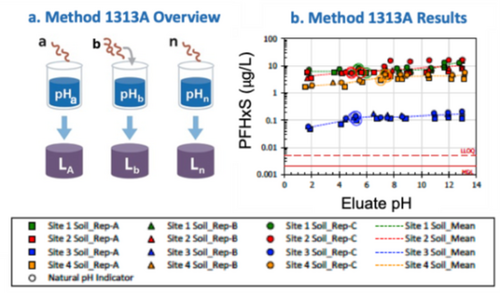
Figure 1: Figure 1. a) Overview of LEAF Method 1313A and b) PFHxS leaching as a function of pH
[1]. Definitions: lower limit of quantification (LLOQ) and method detection limit (MDL)
Draft Method 1313A was used to evaluate pH-dependent leaching in PFAS-contaminated soils in parallel batch extractions where each set of batch reactors is prepared and equilibrated at different pH (Figure 1). Short-chain PFAS (≤6 fluorinated carbons) generally showed little to no variation in leaching across the tested pH range of 2-13 (e.g., PFHxS, Figure 1), whereas long-chain PFAS exhibited increased leaching at higher pH[1]. This trend is consistent with previous findings showing that soil-water partitioning coefficients (Kd) decrease as pH increases (e.g., Higgins and Luthy 2006)[5]. The most pronounced pH effects were observed for perfluoroalkyl sulfonamides (FASAs) such as perfluorooctane sulfonamide (FOSA), which transition from neutral to anionic forms within the circumneutral pH range (~pH 6). The anionic form has a lower Kd and results in higher leaching concentrations[1][6]. For many site management scenarios where pH is circumneutral, variations in anionic PFAS leaching are expected to be small over the relevant pH range. In such cases, when testing time and costs are primary considerations, Method 1313A may be a lower priority relative to evaluating leaching as a function of L/S (Method 1316A, Method 1314A). Different considerations may be needed where FASAs or PFAS with multiple, ionizable functional groups (i.e., zwitterions) are of concern.
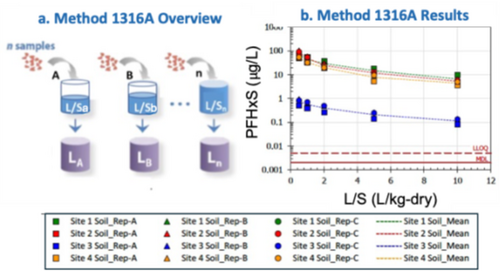
Figure 2: a) Overview of LEAF Method 1316A and b) PFHxS leaching as a function of L/S ratio evaluated in parallel batch leaching vessels
[1]Draft Method 1316A was used to evaluate L/S-dependent leaching of PFAS in impacted soils using parallel batch extractions where each set of batch reactors is prepared and equilibrated at a different L/S. (Figure 2). Methods 1314A and 1316A are similar in intent as they both evaluate leaching as a function of L/S; however, the experimental approach differs. Method 1314A uses a flow-through column configuration (Figure 3; discussed further below). Method 1314A may better simulate field conditions, but Method 1316A is simpler and less costly to implement. Trends in Method 1314A and 1316A are expected to be qualitatively similar but leaching concentrations are expected to exhibit differences. Despite this, leaching studies comparing Methods 1314A and 1316A for inorganics showed that cumulative release results were within one order of magnitude[7].
Method 1316A and Method 1314A may also provide different insights into transport mechanisms. Because Method 1316A is performed using equilibrated batch reactors at varying L/S, results can be used to develop equilibrium desorption isotherms and calculate desorption coefficients (e.g., Kd,desorption). Studies have shown that Kd,desorption values for PFAS may be greater than Kd, an effect often attributed to desorption hysteresis[8]. Consequently Method 1316A provides a straightforward method to estimate site-specific desorption parameters. Although sorption parameters can also be inferred from column (Method 1314A) data, interpretation is often complicated by nonequilibrium processes. Conversely, the column data can be valuable for quantifying those additional mechanisms providing transport parameters that can describe rate-limited transport (e.g., fraction of non-equilibrium sorption sites and sorption rates) and other dynamic behavior.
As anticipated, trends in PFAS leaching obtained during the Method 1316A and Method 1314A demonstrations were qualitatively similar. These are further discussed below.
Column Test Demonstration Studies
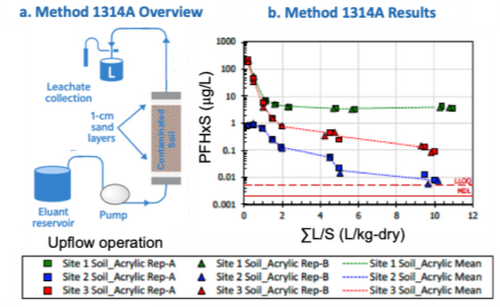
Figure 3. a) Overview of LEAF Method 1314A and b) PFHxS leaching as a function of ∑(L/S) evaluated in saturated up-flow column tests
[1]. Note that acrylic here simply refers to the column material of construction used in this round of Method 1314 testing.
PFAS-specific adaptations were tested in column test demonstration studies, which included triplicate implementation of Method 1314A in three AFFF-impacted site soils.
Draft Method 1314A was implemented in saturated, up-flow columns to evaluate leaching of PFAS as a function of cumulative L/S (∑(L/S)); Figure 3; total volume of water that has passed through the column divided by the soil mass in the column). As noted, the intent of Method 1314a and 1316a is similar, and in both tests, similar qualitative results were observed. For example, short-chain PFAS exhibited high initial concentrations that decreased rapidly. However, in Method 1314a, these rapid drops in short-chain PFAS tended to occur by ∑(L/S) ≈ 2 (e.g., Site 1 and 3 soils, Figure 3) whereas in some cases, such as for PFHxS, Method 1316A produced slightly flatter elution curves than Method 1314A (Figures 2b and 3b). Long-chain PFAS generally displayed flatter elution profiles than short-chain PFAS across both methods. These trends are consistent with chain length dependent sorption documented in the literature[5][6][9]. Although column modeling is beyond the scope of this article, prior studies have shown that saturated transport can be influenced by rate-limited desorption, particularly for long-chain PFAS[10][11]. As noted, data from Methods 1316A and 1314A can support estimation of transport parameters representing equilibrium and nonequilibrium behavior, respectively.
LEAF Screening Evaluations
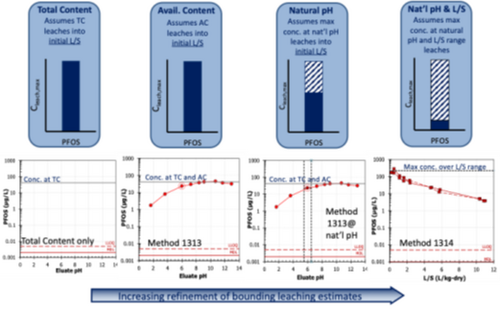
Figure 4. Example screening assessment for perfluorooctane sulfonate (PFOS) using total content and data from Methods 1313A and 1314A. Figure format adapted from Garrabrants
et al. 2021
[12].
LEAF provides a standardized, robust approach for evaluating PFAS release from impacted granular materials under a range of environmental conditions. The tests are complementary, capture a range of conditions, and vary in ease of implementation. This provides the flexibility for users to select the test or test combinations that best suit their project objectives, timeline, and budget. A common use of LEAF data is in screening level assessments. These are stepwise assessments that establish increasingly refined maximum leaching concentrations, Cleach,max (Figure 4), which can then be compared to regulatory limits such as maximum contaminant levels, when available. For example, a stepwise screening assessment might include:
- Assume the maximum leaching concentration is represented by the total content (total initial mass of contaminant present) leaching into the first L/S.
- Assume only the available content leaches into the first L/S where available content is the maximum mass released over pH 2-13 measured using Method 1313a. For many PFAS, total content is equal to available content meaning that all of the PFAS mass is available for leaching.
- Assume the leaching concentration at natural pH (measured in Method 1313A at natural pH or Method 1316A at L/S of 10) is maximum leaching concentration adjusted to the first L/S.
- Consider the maximum leaching concentration over the L/S range (Method 1314A or Method 1316A) and the upper estimate of leaching, or Cleach,max, is the concentration from either Step 3 or Step 4, whichever is greater.
Screening assessments may be sufficient to meet project goals, but when additional refinements of leaching estimates are needed, site-specific data (e.g., infiltration) can be combined with test data and computational approaches (e.g., fate and transport models) for more site-specific estimates of leaching. Example scenarios where LEAF may be used to evaluate PFAS-impacted solids include 1) estimating PFAS release from AFFF-impacted soils, 2) estimating PFAS release from biosolids-amended soils at land application sites, 3) providing transport parameters to model PFAS transport from the source zone to the saturated zone, and 4) evaluating PFAS release from treatment residuals such as soils or sediments treated by soil washing or thermal approaches.
Summary and Ongoing Research
The LEAF framework offers a reliable, replicable approach to evaluating PFAS release from solids. With recent adaptations for PFAS-specific considerations, LEAF methods provide valuable tools for regulators and practitioners in managing PFAS-contaminated materials and assessing long-term environmental risks. However, there are key areas of ongoing research, including:
- An interlab validation of Methods 1313A, 1314A, and 1316A in coordination with the EPA
- Optimization and demonstration of Method 1315A for use with PFAS-impacted solids
- Evaluation of an unsaturated Method 1314A protocol to assess the need for and ability of LEAF testing to capture air-water interfacial partitioning of PFAS
- Application of the total oxidizable precursor (TOP) assay for evaluating the maximum additional PFAS leaching that may occur as a result of polyfluoroalkyl precursor transformation
- Comparison of LEAF testing data to previously collected field-scale enhanced flushing data collected from the same site
Additionally, there are key areas for consideration in future research:
- Collection of paired field-laboratory data under ambient conditions to further validate the applicability of LEAF assessments for estimation of field-relevant PFAS leaching and mobility
- Consideration of biotransformation in modeling and interpretation of LEAF data, as the state of the science regarding biotransformation of polyfluoroalkyl substances to terminal perfluoroalkyl acids advances
Other LEAF Resources
There are numerous resources describing the development of the LEAF leaching methods for inorganics. They are not specific to PFAS, but are still valuable resources focused on LEAF implementation, applications, and management of LEAF data. They include:
References
- ^ 1.0 1.1 1.2 1.3 1.4 1.5 1.6 1.7 Garrabrants, A.C., Liu, F., Warne, R., DeLapp, R., Brown, L., Rubin, Z., Yawson, D., Kosson, D.S., Guelfo, J.L., Real, M.I., van der Sloot, H.A., Touati, A., Thorneloe, S., 2024. Development of Leaching Tests for Materials Containing SVOCs and PFAS, EPA 600/R-23/382, USEPA, Washington, D.C. Free Download EPA 600/R-23/382
- ^ Garrabrants, A.C., Kosson, D.S., Stefanski, L., DeLapp, R., Seignette, P.F.A.B., van der Sloot, H.A., Kariher, P., Baldwin, M., 2012. Interlaboratory Validation of the Leaching Environmental Assessment Framework (LEAF) Method 1313 and Method 1316, EPA/600/R-12/623, U.S. Environmental Protection Agency, Air Pollution and Control Division. Free Download EPA 600/R-12/623
- ^ Garrabrants, A.C., Kosson, D.S., DeLapp, R., Kariher, P., Seignette, P.F.A.B., van der Sloot, H.A., Stefanski, L., Baldwin, M., 2012. Interlaboratory Validation of the Leaching Environmental Assessment Framework (LEAF) Method 1314 and Method 1315, EPA/600/R-12/624, U.S. Environmental Protection Agency, Air Pollution and Control Division. Free Download EPA 600/R-12/624
- ^ USEPA, 2026. Hazardous Waste Test Methods / SW-846. USEPA SW-846 website
- ^ 5.0 5.1 Higgins, C.P., Luthy, R.G., 2006. Sorption of Perfluorinated Surfactants on Sediments. Environmental Science and Technology, 40(23), pp. 7251–7256. doi: 10.1021/es061000n
- ^ 6.0 6.1 Nguyen, T.M.H., Bräunig, J., Thompson, K., Thompson, J., Kabiri, S., Navarro, D.A., Kookana, R.S., Grimison, C., Barnes, C.M., Higgins, C.P., McLaughlin, M.J., Mueller, J.F., 2020. Influences of Chemical Properties, Soil Properties, and Solution pH on Soil–Water Partitioning Coefficients of Per- and Polyfluoroalkyl Substances (PFASs). Environmental Science and Technology, 54(24), pp. 15883–15892. doi: 10.1021/acs.est.0c05705 Open Access Article
- ^ Lopez Meza, S., Garrabrants, A.C., van der Sloot, H., Kosson, D.S., 2008. Comparison of the Release of Constituents from Granular Materials under Batch and Column Testing. Waste Management, 28(10), pp. 1853–1867. doi: 10.1016/j.wasman.2007.11.009
- ^ Schaefer, C.E., Nguyen, D., Christie, E., Shea, S., Higgins, C.P., Field, J., 2022. Desorption Isotherms for Poly- and Perfluoroalkyl Substances in Soil Collected from an Aqueous Film-Forming Foam Source Area. Journal of Environmental Engineering, 148(1), Article 04021074. doi: 10.1061/(ASCE)EE.1943-7870.0001952
- ^ Guelfo, J.L., Higgins, C.P., 2013. Subsurface Transport Potential of Perfluoroalkyl Acids at Aqueous Film-Forming Foam (AFFF)-Impacted Sites. Environmental Science and Technology, 47(9), pp. 4164–4171. doi: 10.1021/es3048043
- ^ Doria-Manzur, A., Gray, E.P., Streets, S.S., Guelfo, J.L., 2025. Per- and Polyfluoroalkyl Substances (PFAS) Transport from Biosolids-Amended Soils: An Experimental and Numerical Approach. Water Research, 288(Part B), Article 124674. doi: 10.1016/j.watres.2025.124674 Open Access Article
- ^ Guelfo, J.L., Wunsch, A., McCray, J., Stults, J.F., Higgins, C.P., 2020. Subsurface Transport Potential of Perfluoroalkyl Acids (PFAAs): Column Experiments and Modeling. Journal of Contaminant Hydrology, 233, Article 103661. doi: 10.1016/j.jconhyd.2020.103661 Open Access Manuscript
- ^ Garrabrants, A.C., Kosson, D.S., Brown, K.G., Fagnant, D.P., Helms, G., Thorneloe, S.A., 2021. Methodology for Scenario-Based Assessments and Demonstration of Treatment Effectiveness Using the Leaching Environmental Assessment Framework (LEAF). Journal of Hazardous Materials, 406, Article 124635. doi: 10.1016/j.jhazmat.2020.124635 Open Access Manuscript
See Also


